Best Electric Vehicle Rentals US: A Strategic Guide
The transition to electric vehicle (EV) transit, when executed through the rental market, represents a fundamental shift in the relationship between operator, machine, and infrastructure. In a traditional internal combustion transit model, the operator is insulated from the limitations of the fuel supply network by the ubiquity of refueling stations. By contrast, the electric rental experience forces the operator to engage directly with the energy architecture of their journey. This is not merely a change in the powertrain; it is a change in the operational philosophy, requiring a move from passive transit—where the vehicle dictates the pace—to active energy management, where the driver must synthesize battery state, charging availability, and topographic demands into a coherent logistical plan.
Navigating this transition effectively requires a high degree of technical skepticism. The marketing surrounding electric mobility often emphasizes simplicity and seamless integration, yet the reality of renting in the current infrastructure landscape involves a complex matrix of variables: differing charging standards, fluctuating station reliability, and the non-linear relationship between ambient temperature and battery performance. To treat an EV rental as a drop-in replacement for a conventional vehicle is a profound miscalculation that can lead to significant disruptions in travel timelines and professional objectives.
This analysis provides a definitive reference for the individual who demands institutional-grade clarity when engaging with the electric rental market. We move beyond the superficial recommendations that populate mainstream travel media to examine the structural realities, risk landscapes, and systemic challenges of the current electrification ecosystem. By establishing a rigorous methodology for appraisal, selection, and operational management, this article serves as a cornerstone for those who seek to achieve long-term topical authority in the management of zero-emission transit.
Understanding “best electric vehicle rentals US.”
A comprehensive investigation into the best electric vehicle rentals us requires a recalibration of what constitutes “best.” In the realm of conventional automotive rentals, the best vehicle is often defined by its aesthetic polish or its interior comfort. In the electric sector, however, the “best” is defined by the resilience of the supporting systems: the vehicle’s energy efficiency, the clarity of its range-estimation software, and, most crucially, the operator’s ability to interface with reliable charging networks. An EV that lacks efficient charging-curve management or clear integration with real-time station data is a liability, regardless of its brand name or luxury status.
The prevailing misunderstanding among the public is that the availability of public charging is a binary state: it either exists or it does not. In reality, the quality of the charging experience is subject to extreme variance. The best electric vehicle rentals us are those that offer a seamless, high-performance interface with the most reliable fast-charging corridors. A renter who prioritizes an EV without verifying the specific charging capabilities of the vehicle—such as its maximum kilowatt-hour (kWh) intake rate versus the available infrastructure—will inevitably face operational bottlenecks. The “best” rental is one that optimizes for the intersection of the vehicle’s peak charging efficiency and the local charging network’s hardware capability.
Furthermore, seeking the best electric vehicle rentals involves a critical look at the provider’s technical support ecosystem. The “best” provider is not the one with the most vehicles, but the one with the most robust, EV-specific recovery and roadside assistance protocol. Without this safety net, the operator assumes a disproportionate amount of risk, essentially acting as the primary technician for an asset they do not own.
Historical Evolution: From Niche Curiosity to Systemic Inflection
The integration of EVs into the American rental fleet has been a process of uneven, reactionary development. As fleet management requirements shifted toward sustainability metrics and carbon-reporting mandates, the pressure to integrate EVs increased, regardless of the accompanying infrastructure challenges. This has led to a market where the fleet deployment often outpaces the supporting charging environment, leaving the renter in the middle of a systemic misalignment.
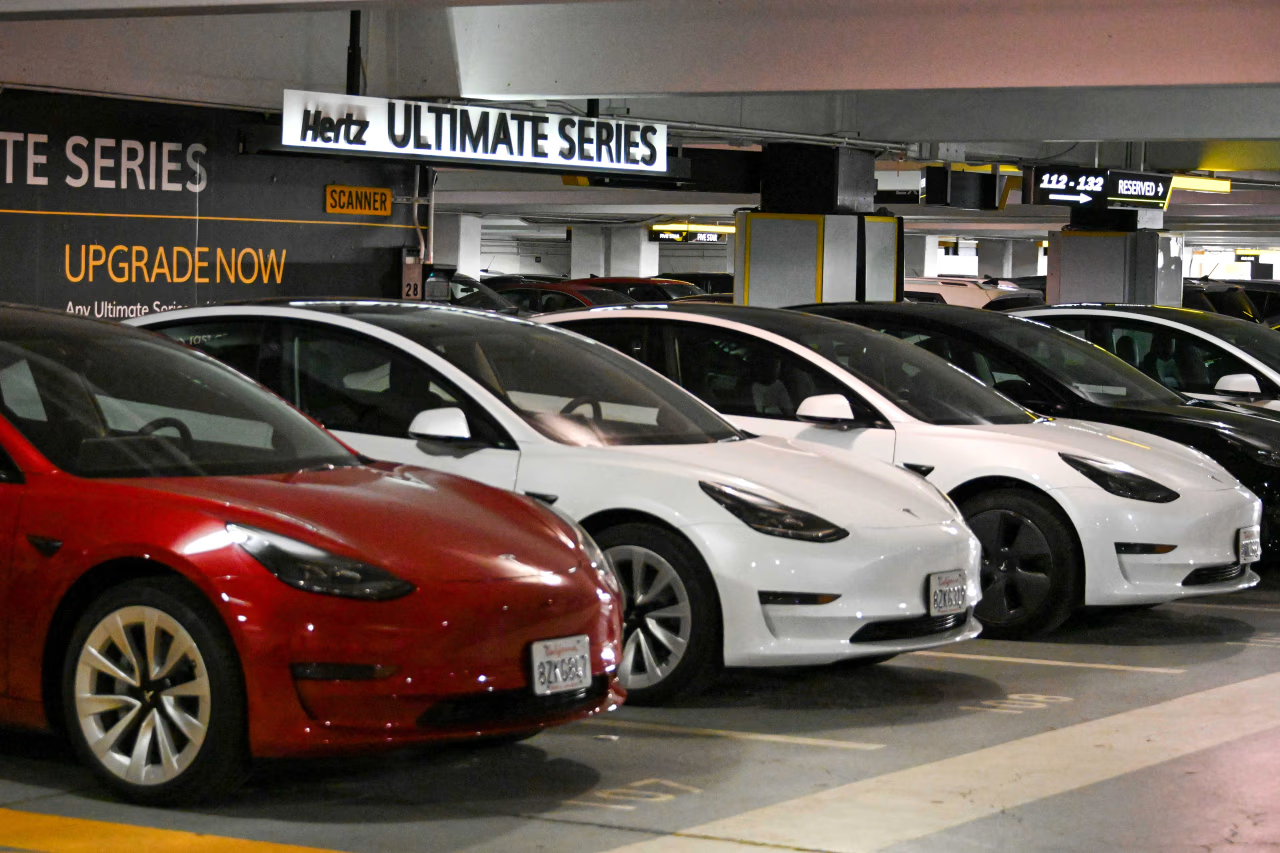
We are currently at an inflection point. The industry is moving from an experimental phase—characterized by limited, high-profile assets—to a functional phase, where reliability and operational consistency are becoming the primary metrics. This transition is being heavily influenced by both private investment in high-speed charging corridors and the hardening of regulatory requirements for fleet sustainability. Understanding this history is vital for the researcher or practitioner, as it highlights why the “best” rental options are currently concentrated in specific high-investment corridors while remaining scarce or unreliable in others.
Conceptual Frameworks and Mental Models
To manage the complexities of electrified transit, the following mental models provide a necessary foundation:
-
The “Energy-Buffer” Protocol: Never plan for a 100% to 0% range. The operational “effective range” is always 20% to 80% of the manufacturer’s rated capacity, which accounts for charging inefficiencies, thermal variations, and the necessity of maintaining a reserve for site-availability failures.
-
The “Infrastructure-Dependency” Index: Analyze the route through the lens of charging redundancy. A route with multiple, independent, high-speed charging providers is exponentially safer than a route dependent on a single network.
-
The “Thermal-Ceiling” Metric: Understand that the charging rate of an EV is not constant; it is constrained by the battery’s temperature. A high-speed charger is useless if the vehicle’s battery management system has not reached the optimal thermal window to accept the high-current flow.
-
The “Software-Integration” Model: The EV is a computer on wheels.
Taxonomy of Rental Variations and Operational Trade-offs
| Asset Category | Charging Standard | Primary Use Case | Risk Factor |
| High-Efficiency Commuter | CCS/NACS (standard) | Short-range urban | Charging speed (low) |
| Long-Haul Touring | High-Current DCFC | Intercity corridor | Network uptime |
| Performance/Luxury | High-Rate Capacity | Status/Short-trip | System complexity |
| Utility/Van | Work/Commercial | Cargo logistics | Efficiency drop/Weight |
Realistic Decision Logic
When identifying the best electric vehicle rentals for us, the selection must be driven by the “Mission-Infrastructure-Match.” If the travel profile involves long-distance transit, the choice must be a vehicle with proven DC-fast-charging stability and high efficiency in high-speed highway conditions. For short, local cycles, the primary decision factor should be the density of the local Level 2 charging network, rather than the vehicle’s top-end charging speed.
Operational Scenarios: Navigating Topographic and Thermal Friction
Scenario 1: The “Cold-Soak” Performance Drop
A renter operates an EV in sub-freezing temperatures for a mountainous transit.
-
The Failure: The battery management system diverts a significant portion of energy to thermal conditioning, and the regenerative braking efficiency drops as the battery cannot accept high-current charging when cold.
-
The Result: The actual range is 30% to 40% less than the advertised EPA range.
-
Second-Order Effect: The operator is forced to abandon the planned charging stops, resulting in a crisis of range confidence.
Scenario 2: The “Network-Congestion” Bottleneck
An operator relies on a single high-speed charging hub for a critical transit corridor. Upon arrival, three of the four stations are non-functional, and the fourth is occupied by a vehicle in a long-duration charge cycle.
-
The Failure: The operator is stranded without an immediate, redundant charging option.
-
The Result: A significant logistical disruption that cascades into lost meetings or delayed arrivals.
-
Second-Order Effect: The psychological erosion of trust in the electrification ecosystem, discouraging future adoption.
Planning, Cost, and Resource Dynamics
The valuation of electric rental transit includes high, non-obvious costs.
| Resource Variable | Direct Cost | Indirect Cost (Opportunity) |
| Charging Fees | Variable (kWh-based) | High (Charging duration) |
| Asset Rental | Variable | Moderate (Charging infrastructure) |
| Time-Buffer | N/A | Very High (Charging downtime) |
| Insurance Riders | Moderate | Moderate (EV-specific coverage) |
A professional budgeting model must allocate a “Contingency-Time” budget, specifically to account for the charging-related friction that is inherent in the current electrified landscape.
Strategic Support Systems and Defensive Documentation
-
The “Pre-Transit Audit”: Insist on a briefing regarding the vehicle’s specific charging interface, as well as the status of the local charging network providers.
-
The “Offline-Manifest”: Relying on an app-dependent system is a failure mode. Carry a printed list of fallback charging sites and critical contact information for roadside assistance.
-
Defensive Condition Audit: Document all charge ports and cable integrity, as well as exterior condition, with high-resolution imagery before usage.
-
Network-Account Pre-Loading: Ensure that all necessary charging network apps and RFID cards are fully activated and loaded with funds before picking up the vehicle.
-
Fluid-Level Monitoring: While EVs have fewer fluids, maintain an awareness of tire pressure and windshield-washer capacity, as these impact efficiency and safety in the same way they do for conventional vehicles.
The Risk Landscape: Compounding Liabilities
-
Energy-Grid Instability: Public charging networks are susceptible to the same outages and technical failures as any complex, distributed infrastructure.
-
Software-Dependence: If the vehicle’s software system loses connectivity, the charging interface, navigation, and energy-management tools may all become compromised.
-
Liability Asymmetry: Rental contracts often contain clauses regarding the damage to charging cables or battery systems that are disproportionately burdensome for the renter.
Governance, Monitoring, and Long-Term Adaptation
-
The Transit Audit: Following a drive, conduct a quiet inspection of the charge-port integrity and confirm that the billing reflected the usage.
-
Adaptive Monitoring: If the machine demonstrates a recurring issue (e.g., erratic charge-rate acceptance), adapt your charging strategy immediately rather than forcing the vehicle to perform.
-
The Layered Checklist: Your packing list should include items that modern rental transit makes redundant: dedicated charging adapters, physical navigation backups, and extended-time logistical buffers.
Metrics, Documentation, and Evaluation
-
Leading Indicator: “Efficiency-per-Kilometer.” (How the vehicle’s actual energy consumption correlates with the expected consumption for the route).
-
Lagging Indicator: “Charging-Session Success.” (The ratio of planned charging stops vs. actual successful charging events).
-
Documentation Example 1: The Electrified Log – A dedicated notebook kept in the vehicle, recording ambient temperature, charging duration, and observed battery-depletion rates.
-
Documentation Example 2: The Condition Passport – A dated record of the vehicle’s state, signed by both the renter and provider upon pick-up and return.
Deconstructing Industrial Misconceptions
-
Myth: “EVs are less complex to maintain.” Correction: The vehicle’s propulsion is less complex, but the logistical maintenance required to operate the EV is more complex.
-
Myth: “Charging is just like stopping for gas.” Correction: Gas stops are refueling; charging stops are logistical, thermal, and electronic management events.
-
Myth: “The most expensive EV is the most efficient.” Correction: High performance often requires higher power draw, which may actually reduce long-term road-trip efficiency.
-
Myth: “Insurance companies have figured out EV risks.” Correction: EV-specific insurance coverage is still evolving and is often misaligned with the actual risks of roadside failure.
-
Myth: “Charging infrastructure is universal.” Correction: The fragmentation of charging networks and standards remains a significant, systemic barrier to seamless transit.
Conclusion: The Synthesis of Strategic Judgments
Engaging with the market for the best electric vehicle rentals is, at its core, a practice in institutionalized skepticism and logistical planning. The operator who successfully utilizes these assets does not do so by accident; they do so by treating the rental not as a passive appliance, but as a critical piece of energy-management infrastructure. By prioritizing infrastructural redundancy, acknowledging the reality of thermal-load constraints, and preparing for the systemic friction of the current charging landscape, the renter ensures that the experience is one of forward-looking mobility rather than logistical struggle. True mastery is the ability to bridge the gap between the vehicle’s technological potential and the current, evolving state of the American infrastructure—a goal that requires both an analytical mind and a pragmatic approach to the realities of electrified transit.